Startup, MSME & Small Business Growth in India: Powering the Nation’s Economic Engine
Government initiatives have also played a role in shaping the current landscape. Policies focused on ease of doing business, startup recognition, digital infrastructure, and formalisation of small enterprises have encouraged more businesses to register and operate within the formal economy. While challenges still exist, the overall direction has helped improve confidence among entrepreneurs.
Access to funding has evolved significantly. While venture capital continues to support high-growth startups, alternative financing options such as NBFC lending, fintech-driven credit, invoice financing, and peer-to-peer lending are becoming more accessible for MSMEs. These options are particularly important for small businesses that may not fit traditional bank lending criteria but still have strong cash flows and growth potential.
However, funding is no longer the only focus. There is a growing emphasis on profitability, unit economics, and long-term sustainability. Investors and founders alike are prioritising strong business fundamentals over rapid but unstable expansion. This shift is helping build more resilient companies capable of surviving market fluctuations.
Startups in India are also increasingly focused on solving local problems with scalable solutions. Whether it is improving last-mile delivery, providing affordable healthcare access, supporting farmers with data-driven insights, or simplifying compliance for small businesses, innovation is becoming more practical and impact-driven. This local relevance gives Indian startups a strong advantage in domestic markets and emerging economies.
Small businesses are benefiting from this innovation wave as well. Many startups now build tools specifically for MSMEs, helping them manage accounting, inventory, payroll, customer relationships, and compliance digitally. These solutions reduce operational friction and allow business owners to focus more on growth and customer experience.
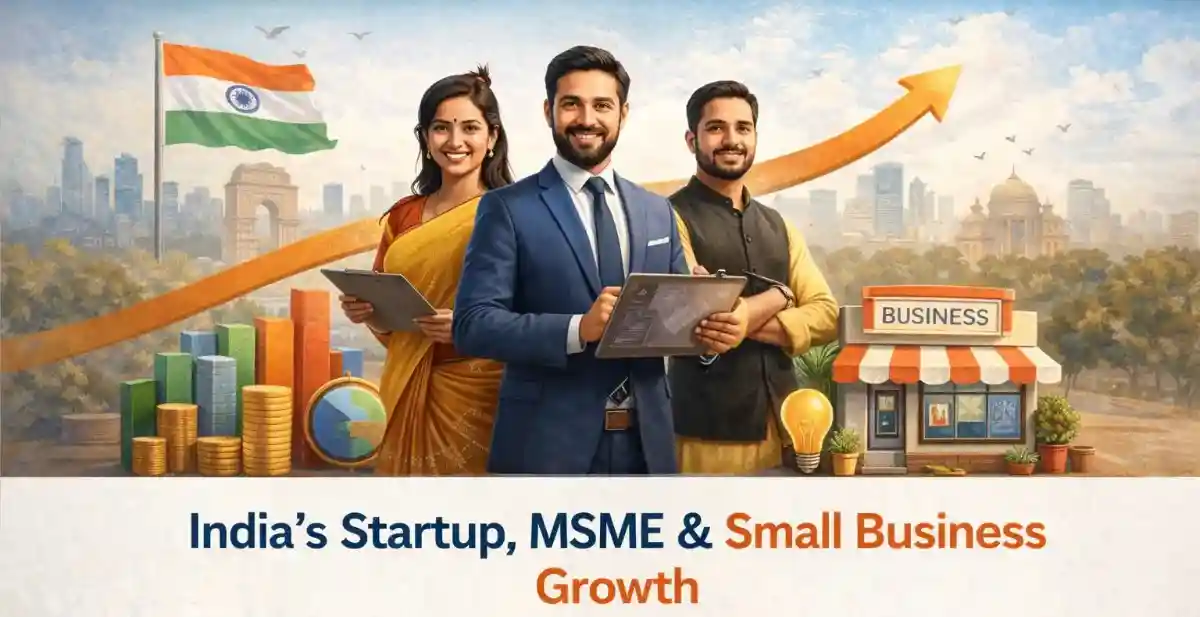
India’s economic story is increasingly being written by startups, micro enterprises, and small businesses operating far beyond metro cities. From tech-enabled startups in Bengaluru to family-run MSMEs in tier-2 and tier-3 towns, entrepreneurship has become one of the strongest drivers of employment, innovation, and local development. As India moves deeper into 2026, the role of startups and MSMEs has shifted from being “supporting players” to becoming central pillars of national growth.
The ecosystem today is not just about big funding rounds or unicorn headlines. It is about sustainability, digital adoption, access to credit, market expansion, and resilience in the face of global uncertainty.
Startups and small businesses are no longer confined to traditional sectors. They are now shaping industries such as fintech, healthtech, agritech, logistics, education, clean energy, manufacturing, and direct-to-consumer brands. This diversification has strengthened India’s entrepreneurial base and reduced dependence on a few high-growth sectors.
One of the biggest reasons behind this growth is the cultural shift toward entrepreneurship. Young professionals are increasingly choosing to build their own ventures rather than rely solely on conventional jobs. At the same time, experienced professionals are launching consultancy firms, niche service companies, and product-based startups after years in corporate roles. This mix of youth-driven innovation and experience-led execution is giving Indian businesses a stronger foundation.
MSMEs continue to play a crucial role in employment generation, especially in semi-urban and rural India. Small manufacturing units, local service providers, traders, and home-grown brands collectively employ millions and contribute significantly to India’s domestic production. Their importance became even more evident in recent years, as local supply chains proved more resilient than global ones during disruptions.
Digital transformation has been a major growth catalyst for startups and small businesses. Affordable internet, smartphones, and digital payment systems have helped even the smallest businesses go online. From accepting UPI payments to selling products through e-commerce platforms and social media, digital tools are now essential rather than optional. This shift has helped MSMEs reach customers beyond their immediate geography and compete on a much larger scale.
Government initiatives have also played a role in shaping the current landscape. Policies focused on ease of doing business, startup recognition, digital infrastructure, and formalisation of small enterprises have encouraged more businesses to register and operate within the formal economy. While challenges still exist, the overall direction has helped improve confidence among entrepreneurs.
Access to funding has evolved significantly. While venture capital continues to support high-growth startups, alternative financing options such as NBFC lending, fintech-driven credit, invoice financing, and peer-to-peer lending are becoming more accessible for MSMEs. These options are particularly important for small businesses that may not fit traditional bank lending criteria but still have strong cash flows and growth potential.
However, funding is no longer the only focus. There is a growing emphasis on profitability, unit economics, and long-term sustainability. Investors and founders alike are prioritising strong business fundamentals over rapid but unstable expansion. This shift is helping build more resilient companies capable of surviving market fluctuations.
Startups in India are also increasingly focused on solving local problems with scalable solutions. Whether it is improving last-mile delivery, providing affordable healthcare access, supporting farmers with data-driven insights, or simplifying compliance for small businesses, innovation is becoming more practical and impact-driven. This local relevance gives Indian startups a strong advantage in domestic markets and emerging economies.
Small businesses are benefiting from this innovation wave as well. Many startups now build tools specifically for MSMEs, helping them manage accounting, inventory, payroll, customer relationships, and compliance digitally. These solutions reduce operational friction and allow business owners to focus more on growth and customer experience.