Digital India & Governance Updates: How Technology Is Reshaping Public Services in 2026
Citizens can access certificates, subsidies, welfare benefits, and official documents without standing in long queues or dealing with middlemen. This shift has not only saved time but has also reduced corruption and administrative delays.
Government departments are increasingly sharing data securely, enabling faster decision-making and more efficient service delivery.
E-Governance Services Reach Deeper Into Rural India
Digital governance is no longer limited to urban centers. With improved internet connectivity and smartphone penetration, rural India is witnessing greater access to online public services.
Village-level service centers and digital kiosks are helping citizens:
- Apply for government schemes
- Access land and revenue records
- Complete digital payments
- Receive welfare benefits directly into bank accounts
This expansion is playing a key role in bridging the urban-rural digital divide, although challenges such as digital literacy and connectivity gaps still remain.
Digital Payments Strengthen Transparency
India’s move toward a cash-light economy continues to strengthen governance outcomes. Digital payments are now a standard feature across public services, including transport, utilities, education, and municipal services.
For governance, this shift brings:
- Better financial tracking
- Reduced leakages in welfare schemes
- Faster disbursement of funds
- Improved accountability
Citizens also benefit from ease of use and clear transaction records, making public interactions more transparent.
Citizen-Centric Platforms Improve Engagement
A major focus of governance reforms in 2026 is citizen engagement. Feedback portals, grievance redressal systems, and real-time dashboards allow people to interact directly with government departments.
Citizens can now:
- Register complaints online
- Track application status
- Access real-time updates on public projects
- Participate in surveys and consultations
This two-way communication is helping authorities identify issues faster and improve service quality.
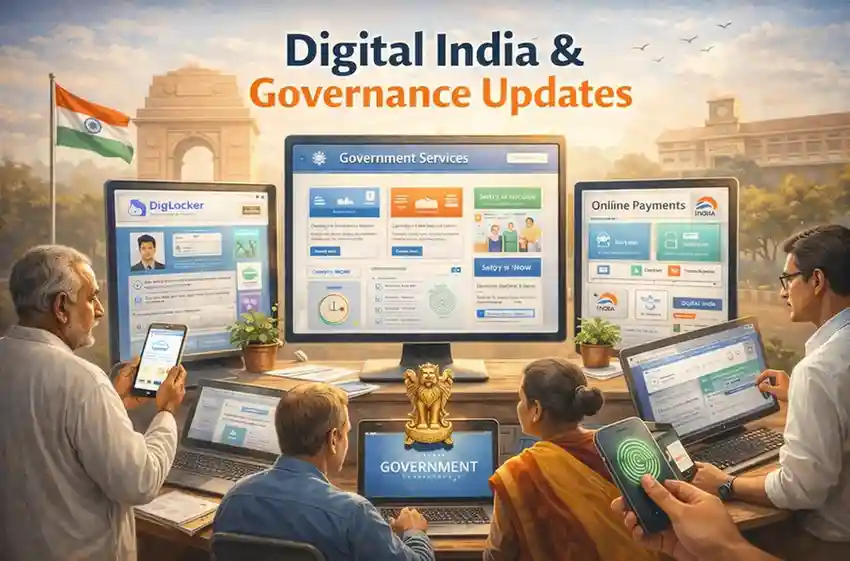
India’s digital governance journey has entered a more mature and impact-driven phase in 2026. What began as an ambitious vision under the Digital India initiative has now become a part of everyday life for millions of citizens. From accessing government services online to using digital identity for seamless verification, technology is steadily reducing bureaucracy and increasing transparency across the country.
Today, digital governance in India is no longer just about launching portals or apps. It is about delivery, inclusion, security, and trust—ensuring that technology actually works for people at the grassroots level.
Digital Public Infrastructure Becomes the Backbone of Governance
One of the biggest developments in recent years has been the strengthening of India’s digital public infrastructure. Platforms such as digital identity systems, online payment networks, and cloud-based government services are now deeply integrated into governance.
Citizens can access certificates, subsidies, welfare benefits, and official documents without standing in long queues or dealing with middlemen. This shift has not only saved time but has also reduced corruption and administrative delays.
Government departments are increasingly sharing data securely, enabling faster decision-making and more efficient service delivery.
E-Governance Services Reach Deeper Into Rural India
Digital governance is no longer limited to urban centers. With improved internet connectivity and smartphone penetration, rural India is witnessing greater access to online public services.
Village-level service centers and digital kiosks are helping citizens:
- Apply for government schemes
- Access land and revenue records
- Complete digital payments
- Receive welfare benefits directly into bank accounts
This expansion is playing a key role in bridging the urban-rural digital divide, although challenges such as digital literacy and connectivity gaps still remain.
Digital Payments Strengthen Transparency
India’s move toward a cash-light economy continues to strengthen governance outcomes. Digital payments are now a standard feature across public services, including transport, utilities, education, and municipal services.
For governance, this shift brings:
- Better financial tracking
- Reduced leakages in welfare schemes
- Faster disbursement of funds
- Improved accountability
Citizens also benefit from ease of use and clear transaction records, making public interactions more transparent.
Citizen-Centric Platforms Improve Engagement
A major focus of governance reforms in 2026 is citizen engagement. Feedback portals, grievance redressal systems, and real-time dashboards allow people to interact directly with government departments.
Citizens can now:
- Register complaints online
- Track application status
- Access real-time updates on public projects
- Participate in surveys and consultations
This two-way communication is helping authorities identify issues faster and improve service quality.