Trump’s Nuclear Arms Control Push With Russia Hinges on China
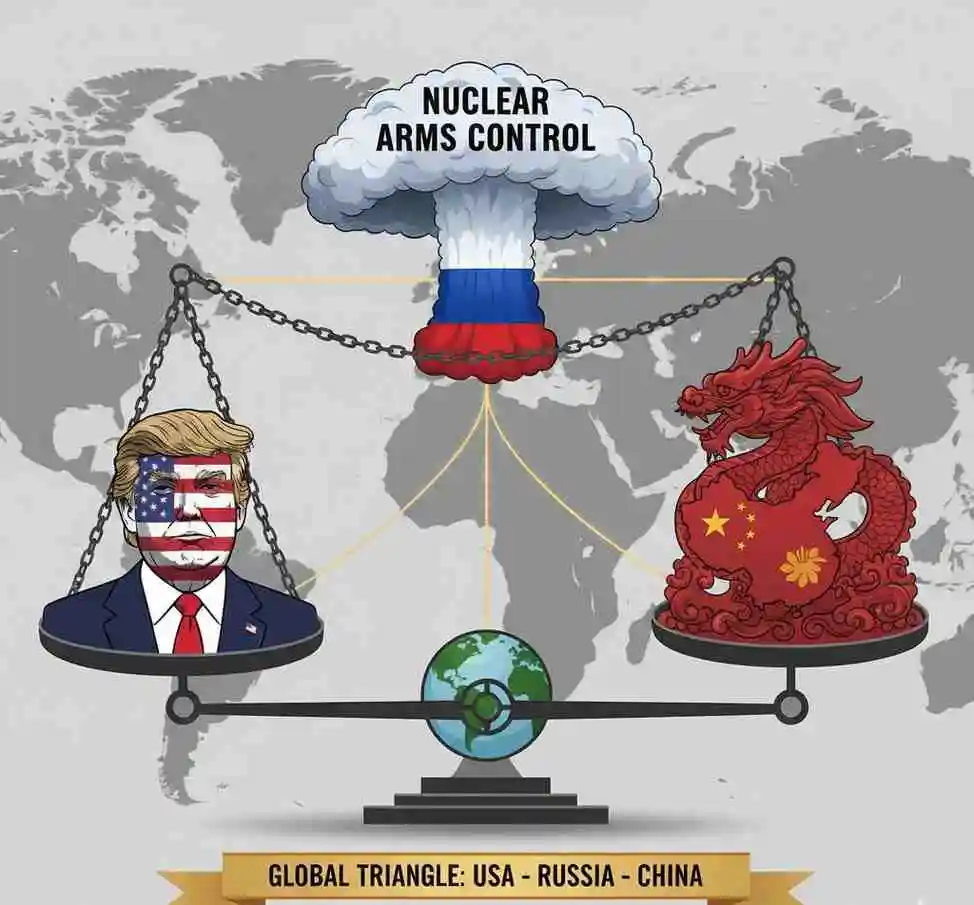
Trump’s Nuclear Gamble: Why China Is the Missing Piece
As global tensions simmer and old arms control agreements lie in pieces, Donald Trump’s renewed push to restart nuclear arms control talks with Russia has resurfaced an old but unresolved question: Can nuclear stability be achieved without China at the table?
For Trump, who has long criticized Cold War–era arms agreements as outdated and unfair, the answer is clear: any meaningful nuclear deal in the 21st century must include China. But for Russia, China, and much of the international community, that demand complicates an already fragile strategic landscape.
This evolving diplomatic puzzle highlights not only the shifting balance of global power but also the deep uncertainty surrounding nuclear risk in a multipolar world.
☢️ A Broken Architecture of Nuclear Control
For decades, global nuclear stability rested on a web of agreements negotiated primarily between Washington and Moscow. Treaties such as START, New START, and INF helped cap arsenals, enforce transparency, and reduce the risk of accidental war.
That architecture is now largely dismantled.
- The INF Treaty collapsed, ending limits on intermediate-range missiles.
- New START, the last major treaty capping U.S. and Russian strategic weapons, hangs by a thread.
- Mutual trust has eroded amid geopolitical rivalries, sanctions, and ongoing conflicts.
Trump has repeatedly argued that these frameworks no longer reflect reality, especially as China rapidly modernizes and expands its nuclear forces.
Why China Changes Everything
China was once a marginal nuclear power compared to the U.S. and Russia. That is no longer the case.
Beijing is:
- Expanding its nuclear missile silos
- Developing hypersonic weapons
- Modernizing delivery systems across land, sea, and air
While China still maintains a smaller arsenal than Washington or Moscow, its growth trajectory alarms U.S. strategists.
From Trump’s perspective, negotiating limits with Russia alone would lock the U.S. into constraints while China remains unconstrained a scenario he has repeatedly labeled “strategically irresponsible.”
🧠 Trump’s Strategic Logic
Trump’s position follows a simple if controversial logic:
- Bilateral treaties are obsolete
- China is the fastest-rising nuclear power
- Any future deal must reflect today’s power balance
He has framed arms control not as disarmament, but as competitive fairness. In this view, a trilateral framework involving the U.S., Russia, and China is the only way to prevent imbalance and strategic disadvantage.
However, what sounds logical on paper becomes far more complex in practice.
Russia’s Calculated Ambivalence
Russia’s stance is cautious and tactical.
On one hand, Moscow:
- Welcomes talks that reduce U.S. pressure
- Sees arms control as a way to reassert parity with Washington
On the other hand:
- Russia values its strategic partnership with China
- It resists being used as leverage to force Beijing into negotiations
Russian officials have repeatedly said China’s participation must be voluntary, not imposed as a precondition, a direct contradiction of Trump’s approach.
🚫 China’s Firm Refusal
China has been unequivocal: it does not want in.
Beijing argues:
- Its arsenal is far smaller than that of the U.S. and Russia
- Existing treaties were designed for Cold War superpowers
- Any trilateral framework would unfairly restrict its defensive needs
China has instead called for the U.S. and Russia to reduce their stockpiles first, creating a more equal baseline before Beijing considers formal limits.
This fundamental disagreement creates a diplomatic stalemate.
⚠️ The Risk of No Deal at All
Here’s the core danger: insisting on China could mean no deal whatsoever.
Without New START or a successor treaty:
- Nuclear arsenals expand unchecked
- Transparency disappears
- Miscalculation risks rise sharply
Military strategists caution that the lack of regulations raises the possibility of unintentional escalation, particularly in situations involving cyberwarfare, space assets, or local conflicts.
Even those who oppose arms control agree that some restrictions are preferable to none at all.
🌐 A Multipolar Nuclear World
What makes this moment uniquely dangerous is the transition from a bipolar to a multipolar nuclear system.
Beyond China, other nuclear powers are modernizing:
- India and Pakistan
- North Korea
- France and the UK
Unprecedented diplomatic coordination is needed to replace the outdated U.S.-Russian model, which no longer reflects reality.
Whether one supports Trump's initiative or not, it brings to light this unsettling reality: in the multipolar age, there is no clear plan for nuclear governance.