
Canada and France to Open Greenland Consulates After Trump Demands: A New Chapter in Arctic Geopolitics
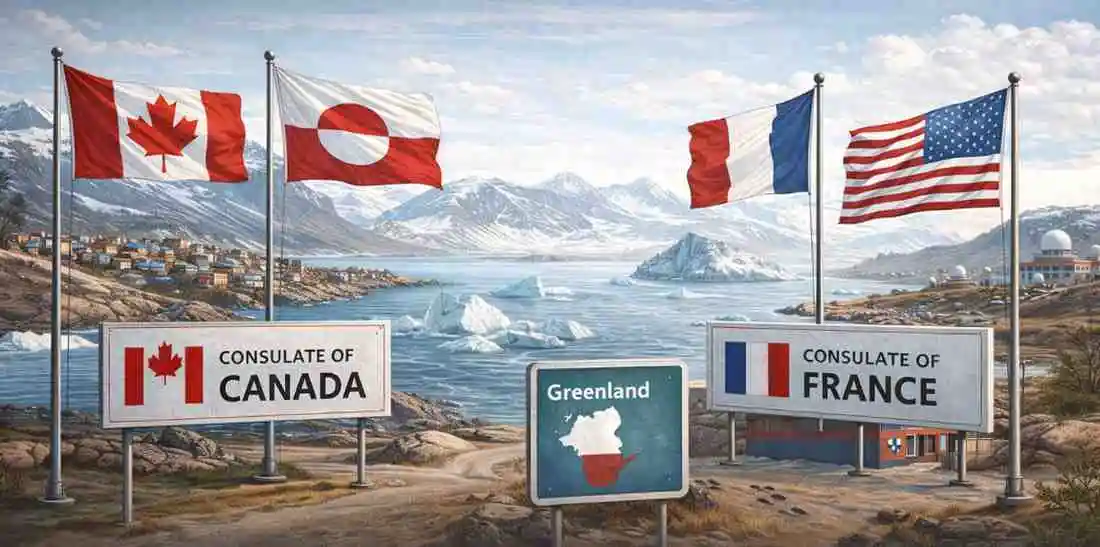
The Arctic, once viewed as a distant and frozen frontier, is rapidly becoming one of the most strategically significant regions in the world. In a move that underscores this shift, have announced plans to open consulates in Greenland, responding to renewed international attention and controversy sparked by former U.S. President Donald Trump’s repeated demands and remarks about Greenland.
The decision signals more than just an expanded diplomatic presence. It reflects growing global competition in the Arctic, where climate change, security concerns, and resource access are reshaping geopolitical priorities. As major powers reposition themselves, Greenland, a vast island with a small population but immense strategic value, finds itself at the center of an intensifying international spotlight.
🌍 Why Greenland Matters More Than Ever
Greenland is an autonomous territory in the Kingdom of Denmark. It has been important in global politics for a long time because it is in a strategic location between North America and Europe. But in the last few years, it has become much more important.
As Arctic ice melts at unprecedented rates, new shipping routes are opening, mineral and rare-earth resources are becoming more accessible, and military positioning in the High North has taken on new urgency. These changes have transformed Greenland from a peripheral territory into a key node in global power calculations.
The island also hosts critical infrastructure, including a major U.S. air base at Thule (now known as Pituffik Space Base), reinforcing its importance to NATO and Western security frameworks.
Why Canada and France Are Stepping In
Canada’s Arctic Imperative
For Canada, opening a consulate in Greenland aligns closely with its long-standing emphasis on Arctic sovereignty and northern diplomacy. Ottawa has consistently viewed the Arctic as central to its national identity, security, and environmental strategy.
By establishing a formal diplomatic presence in Greenland, Canada aims to:
- Strengthen cooperation on Indigenous issues
- Improve Arctic research and environmental collaboration
- Coordinate on security, shipping, and climate resilience
- Reinforce its role as a key Arctic stakeholder
Canadian officials have framed the move as part of a broader effort to ensure that Arctic governance remains rules-based and cooperative, rather than dominated by unilateral power plays.
France’s Strategic Signal
France’s decision may appear less obvious at first glance, but it reflects Paris’s growing interest in polar diplomacy. As a nation with overseas territories and a strong global diplomatic footprint, France has increasingly positioned itself as a player in Arctic and Antarctic affairs.
Opening a consulate in Greenland allows France to:
- Expand its influence within Arctic governance forums
- Support scientific research and climate monitoring
- Strengthen ties with Nordic countries and Denmark
- Signal its commitment to multilateral engagement in emerging strategic regions
For France, the Arctic is no longer a distant concern it is a frontier where climate, security, and global governance intersect.
Trump’s Greenland Demands: The Spark That Reignited the Debate
The increased activity of foreign diplomats can be traced back to Donald Trump's recent comments about Greenland and interest in purchasing this territory from Denmark, which were met with widespread criticism and ridicule in 2019 when he suggested would buy this Danish territory but were based on legitimate national security issues regarding Norway's and Russia's influence in the Arctic and competition between the U.S. and China for resources.
This time around, though, his comments now have more respectability because he remains a major player discourse, and they remind Western nations to consider Greenland's future before it is treated as an afterthought by other countries.
The implication to both Canada and France is that the Arctic will not be influenced by one nation's selfish agenda; rather, they must work together with a focus on long-term control, compatibility, and partnership amongst all interested parties in order to prevent unilateral decisions on any matter affecting the Arctic region of the globe.
🇩🇰 Denmark and Greenland: Balancing Autonomy and Alliances
Denmark, which oversees Greenland’s foreign and defense policy, has reacted cautiously but pragmatically to the announcement of new consulates. Copenhagen has long encouraged responsible international engagement with Greenland, provided it respects the island’s autonomy and local priorities.
For Greenland itself, increased diplomatic presence brings both opportunities and challenges.
Opportunities
- Greater international investment and cooperation
- Expanded global voice on climate change and Indigenous rights
- Diversification of economic partnerships
Concerns
- Risk of becoming a pawn in great-power competition
- Pressure on local governance structures
- Environmental risks linked to resource extraction
Greenlandic leaders have repeatedly emphasized that any foreign engagement must align with local interests, especially as the territory continues to debate its long-term political future, including the possibility of greater independence.