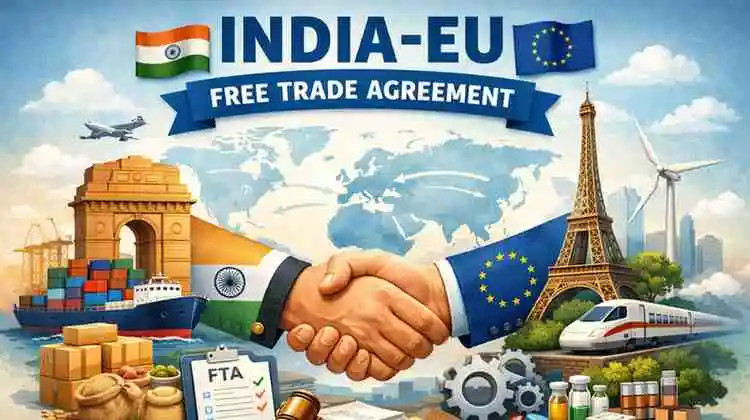
India–EU Trade Agreement Explained: Why It Matters for India and Europe
https://www.theglobalvission.com/
Publish Date- 28 जनवरी 2026
The Great Economic Bridge: A Deep Dive into the India-EU Free Trade Agreement
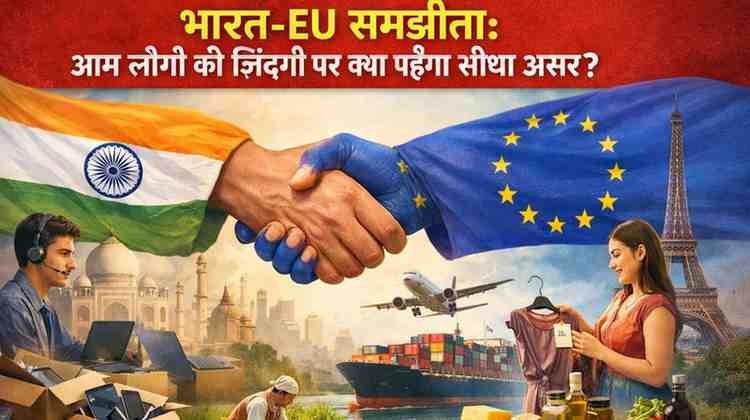
In the world of global politics, "Free Trade Agreements" (FTAs) often sound like the kind of things that happen in windowless rooms in Brussels or New Delhi—distant, dry, and disconnected from daily life. But the India-EU Trade Agreement currently being hammered out is different. It isn’t just a contract; it is a fundamental shift in how one-sixth of the human population interacts with the world’s most sophisticated trading bloc.
If you’ve ever wondered why an iPhone costs what it does, why your local IT firm is hiring, or why certain medicines are affordable while others aren’t, you are already looking at the ripples of trade policy.
1. The "Why Now?" Moment: Geopolitics Meets Economics
To understand this deal, you have to understand the timing. India and the EU have been "dating" since 2007, but the relationship has been rocky. They walked away from the table in 2013 because neither side was ready to budge.
So, what changed in 2022? The world got messy. Between the global pandemic disrupting supply chains and the geopolitical shift caused by the war in Ukraine, both India and Europe realized they couldn't put all their eggs in one basket (namely, China).
Europe needs a stable, democratic, and massive manufacturing partner. India needs high-end technology, green energy investment, and a "premium" market for its exports. Suddenly, the things that kept them apart for a decade seemed small compared to the benefits of joining forces.
2. Breaking Down the Pillars: What’s Actually on the Table?
A modern trade deal is about much more than just shipping crates. It’s a three-headed dragon consisting of Trade, Investment, and Geographical Indications (GIs).
A. Trade in Goods: The "Physical" Stuff
This is what most people think of. It’s about Tariffs—the taxes countries charge on imports.
For India: Imagine Indian-made shirts, leather shoes, or bags being sold in Paris or Berlin without a 10-12% tax added at the border. That makes Indian products the "obvious choice" for European shoppers.
For the EU: Imagine German cars or French wines being sold in Mumbai without the eye-watering 100% to 150% import duties that currently exist.
B. Trade in Services: The "Brain" Export
This is where India has the "home-court advantage." India’s IT sector is a global behemoth. A successful FTA would mean fewer visa hurdles for Indian engineers and consultants to work on projects in Europe. It’s about Mode 4 movement—the technical term for professionals moving across borders to provide services.
C. Investment Protection: The "Safety Net"
European companies are often hesitant to pour billions into India because they fear legal red tape or changing regulations. This agreement aims to create a "legal shield" that protects these investments, encouraging a flood of European capital into Indian infrastructure and tech.
3. The "Sticking Points": Why This Isn't Signed Yet
If this is such a win-win, why haven't they signed the papers? Because the "Devil is in the details," and these details are incredibly sensitive.
The "Green" Wall: CBAM and Sustainability
The EU is obsessed with climate change (rightfully so). They are introducing the Carbon Border Adjustment Mechanism (CBAM). Essentially, if you make steel using "dirty" coal power, the EU wants to tax you at the border to level the playing field for their "green" factories. India argues this is a "trade barrier in disguise" that hurts developing nations that are still transitioning to green energy.
The Pharmacy of the World
India is the world's leader in "generic" drugs—affordable versions of expensive medicines. The EU has a massive pharmaceutical industry that wants stricter Intellectual Property (IP) rules. If India agrees to the EU’s strict standards, there is a risk that life-saving medicines could become too expensive for the common person. This is a moral and economic tug-of-war.
Dairy and Agriculture
In Europe, farming is highly subsidized. In India, farming is the livelihood of hundreds of millions of people. If India allows cheap European milk or cheese to flood the market, it could bankrupt millions of local dairy farmers. This makes agriculture a "no-go" zone for many Indian negotiators.
4. Sector-by-Sector Impact: Who Wins and Who Struggles?
The Big Winners:
Textiles & Apparel: India’s garment industry has been losing ground to Vietnam and Bangladesh (who have better trade deals). An FTA with the EU would put India back in the lead.
Digital Economy: India's startups are hungry for European venture capital and data-sharing agreements.
Renewable Energy: Europe leads in wind and solar tech. India has the sun and the space. It’s a match made in heaven.
The Challenged Sectors:
Automotive: Indian car manufacturers might struggle if high-end European cars suddenly become 50% cheaper.
Small-Scale Manufacturers: The EU has very strict "SPS" (Sanitary and Phytosanitary) standards. An Indian spice maker or toy manufacturer might find it very expensive to upgrade their factory to meet European safety rules.
5. How It Affects You (The Ordinary Person)
Most people assume trade deals are for CEOs, but the effects trickled down to your wallet and your career.
Job Market: If a European tech giant decides to move its R&D center to Bangalore or Pune because of this deal, that’s thousands of high-paying jobs created.
Consumer Choice: You might see a wider variety of high-quality European appliances or foods at your local supermarket at prices that don't feel like a luxury.
Education & Travel: Trade deals often lead to "Mutual Recognition Agreements." This means an Indian degree might be more easily recognized in Europe, making it simpler for students and professionals to move between the two regions.
6. The "China Plus One" Strategy
We cannot talk about this deal without mentioning the elephant in the room: China. For decades, the world relied on China for everything. Recent global tensions have made everyone nervous. The "China Plus One" strategy is Europe’s way of saying, "We need another partner just as big as China, but more aligned with our values." India is the only country that fits that description. This deal is as much about security as it is about shopping.
7. The Road Ahead: What to Expect in 2026 and Beyond
Negotiations are currently in high gear. We are seeing "Round after Round" of talks, with officials meeting every few months.
What happens next?
The "Drafting" Phase: Both sides are currently trading "offers"—basically saying, "I'll lower the tax on your wine if you lower the tax on my rice."
The "Legal Scrub": Lawyers will spend months making sure there are no loopholes.
Ratification: Even after the leaders sign it, the parliaments (all 27 EU countries plus India) have to say "Yes."
Conclusion: Is it a Game Changer?
In a word: Yes. The India-EU Trade Agreement is the final piece of the puzzle for India’s emergence as a global economic superpower. For the EU, it’s a way to remain relevant and fueled by the world's most vibrant young workforce.
It won’t happen overnight, and there will be plenty of arguments along the way. But when the dust settles, the map of global trade will look very different. The "Silk Road" of the past is being replaced by a digital, green, and high-tech highway between New Delhi and Brussels.
">
Author Name: Anshika Singh
Author Profile Link: https://www.theglobalvission.com/
Publish Date- 28 जनवरी 2026
The Great Economic Bridge: A Deep Dive into the India-EU Free Trade Agreement
In the world of global politics, "Free Trade Agreements" (FTAs) often sound like the kind of things that happen in windowless rooms in Brussels or New Delhi—distant, dry, and disconnected from daily life. But the India-EU Trade Agreement currently being hammered out is different. It isn’t just a contract; it is a fundamental shift in how one-sixth of the human population interacts with the world’s most sophisticated trading bloc.
If you’ve ever wondered why an iPhone costs what it does, why your local IT firm is hiring, or why certain medicines are affordable while others aren’t, you are already looking at the ripples of trade policy.
1. The "Why Now?" Moment: Geopolitics Meets Economics
To understand this deal, you have to understand the timing. India and the EU have been "dating" since 2007, but the relationship has been rocky. They walked away from the table in 2013 because neither side was ready to budge.
So, what changed in 2022? The world got messy. Between the global pandemic disrupting supply chains and the geopolitical shift caused by the war in Ukraine, both India and Europe realized they couldn't put all their eggs in one basket (namely, China).
Europe needs a stable, democratic, and massive manufacturing partner. India needs high-end technology, green energy investment, and a "premium" market for its exports. Suddenly, the things that kept them apart for a decade seemed small compared to the benefits of joining forces.
2. Breaking Down the Pillars: What’s Actually on the Table?
A modern trade deal is about much more than just shipping crates. It’s a three-headed dragon consisting of Trade, Investment, and Geographical Indications (GIs).
A. Trade in Goods: The "Physical" Stuff
This is what most people think of. It’s about Tariffs—the taxes countries charge on imports.
For India: Imagine Indian-made shirts, leather shoes, or bags being sold in Paris or Berlin without a 10-12% tax added at the border. That makes Indian products the "obvious choice" for European shoppers.
For the EU: Imagine German cars or French wines being sold in Mumbai without the eye-watering 100% to 150% import duties that currently exist.
B. Trade in Services: The "Brain" Export
This is where India has the "home-court advantage." India’s IT sector is a global behemoth. A successful FTA would mean fewer visa hurdles for Indian engineers and consultants to work on projects in Europe. It’s about Mode 4 movement—the technical term for professionals moving across borders to provide services.
C. Investment Protection: The "Safety Net"
European companies are often hesitant to pour billions into India because they fear legal red tape or changing regulations. This agreement aims to create a "legal shield" that protects these investments, encouraging a flood of European capital into Indian infrastructure and tech.
3. The "Sticking Points": Why This Isn't Signed Yet
If this is such a win-win, why haven't they signed the papers? Because the "Devil is in the details," and these details are incredibly sensitive.
The "Green" Wall: CBAM and Sustainability
The EU is obsessed with climate change (rightfully so). They are introducing the Carbon Border Adjustment Mechanism (CBAM). Essentially, if you make steel using "dirty" coal power, the EU wants to tax you at the border to level the playing field for their "green" factories. India argues this is a "trade barrier in disguise" that hurts developing nations that are still transitioning to green energy.
The Pharmacy of the World
India is the world's leader in "generic" drugs—affordable versions of expensive medicines. The EU has a massive pharmaceutical industry that wants stricter Intellectual Property (IP) rules. If India agrees to the EU’s strict standards, there is a risk that life-saving medicines could become too expensive for the common person. This is a moral and economic tug-of-war.
Dairy and Agriculture
In Europe, farming is highly subsidized. In India, farming is the livelihood of hundreds of millions of people. If India allows cheap European milk or cheese to flood the market, it could bankrupt millions of local dairy farmers. This makes agriculture a "no-go" zone for many Indian negotiators.
4. Sector-by-Sector Impact: Who Wins and Who Struggles?
The Big Winners:
Textiles & Apparel: India’s garment industry has been losing ground to Vietnam and Bangladesh (who have better trade deals). An FTA with the EU would put India back in the lead.
Digital Economy: India's startups are hungry for European venture capital and data-sharing agreements.
Renewable Energy: Europe leads in wind and solar tech. India has the sun and the space. It’s a match made in heaven.
The Challenged Sectors:
Automotive: Indian car manufacturers might struggle if high-end European cars suddenly become 50% cheaper.
Small-Scale Manufacturers: The EU has very strict "SPS" (Sanitary and Phytosanitary) standards. An Indian spice maker or toy manufacturer might find it very expensive to upgrade their factory to meet European safety rules.
5. How It Affects You (The Ordinary Person)
Most people assume trade deals are for CEOs, but the effects trickled down to your wallet and your career.
Job Market: If a European tech giant decides to move its R&D center to Bangalore or Pune because of this deal, that’s thousands of high-paying jobs created.
Consumer Choice: You might see a wider variety of high-quality European appliances or foods at your local supermarket at prices that don't feel like a luxury.
Education & Travel: Trade deals often lead to "Mutual Recognition Agreements." This means an Indian degree might be more easily recognized in Europe, making it simpler for students and professionals to move between the two regions.
6. The "China Plus One" Strategy
We cannot talk about this deal without mentioning the elephant in the room: China. For decades, the world relied on China for everything. Recent global tensions have made everyone nervous. The "China Plus One" strategy is Europe’s way of saying, "We need another partner just as big as China, but more aligned with our values." India is the only country that fits that description. This deal is as much about security as it is about shopping.
7. The Road Ahead: What to Expect in 2026 and Beyond
Negotiations are currently in high gear. We are seeing "Round after Round" of talks, with officials meeting every few months.
What happens next?
The "Drafting" Phase: Both sides are currently trading "offers"—basically saying, "I'll lower the tax on your wine if you lower the tax on my rice."
The "Legal Scrub": Lawyers will spend months making sure there are no loopholes.
Ratification: Even after the leaders sign it, the parliaments (all 27 EU countries plus India) have to say "Yes."
Conclusion: Is it a Game Changer?
In a word: Yes. The India-EU Trade Agreement is the final piece of the puzzle for India’s emergence as a global economic superpower. For the EU, it’s a way to remain relevant and fueled by the world's most vibrant young workforce.
It won’t happen overnight, and there will be plenty of arguments along the way. But when the dust settles, the map of global trade will look very different. The "Silk Road" of the past is being replaced by a digital, green, and high-tech highway between New Delhi and Brussels.